
The World of Marketing is Changing Fast
Welcome to early 2026. If you feel like the internet is different than it was a few years ago, you are right.
We are currently in what experts call an “AI feature blizzard”. Tools like ChatGPT, Google Gemini, and Perplexity have changed how people get answers.
In the old days (like 2020), if you wanted to find a lawyer, you went to Google, typed in “best personal injury lawyer near me” and clicked on a few links. Today, many people just ask an AI. Because of this, experts predict that traditional search volume — people clicking on those old “blue links” — will drop by about 25% this year.
However, this doesn’t mean “SEO is dead”. In fact, Google still handles over 90% of the world’s searches. What has changed is how you show up. You don’t just want to be a link on a page anymore; you want the AI to talk about you and recommend you to the person asking the question.
This report will explain the new rules of the game. We will look at how AI picks its favorites, why your customers are “bouncing” around like pinballs, and how you can keep your business visible in this new world.
Key Concept: What is GEO?
To succeed in 2026, you need to understand a new term: GEO, or Generative Engine Optimization.
SEO
Search Engine Optimization — the old way of ranking high on Google.
Think of SEO as trying to get your book onto a library shelf.
GEO
Generative Engine Optimization — the new version. It is the practice of setting up your website and your stories so that AI “answer engines” like ChatGPT or Google’s AI Overviews will find you, trust you, and cite you as a source.
Think of GEO as trying to get the librarian to actually read a quote from your book to someone asking a question.
Why GEO Matters
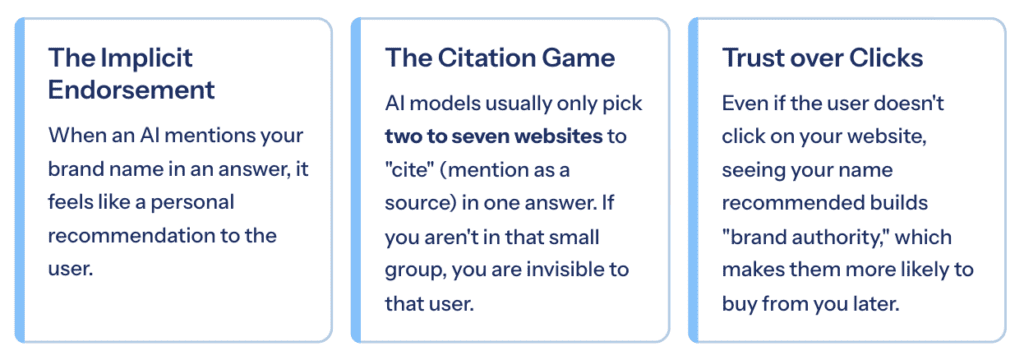
The Implicit Endorsement
When an AI mentions your brand name in an answer, it feels like a personal recommendation to the user.
The Citation Game
AI models usually only pick two to seven websites to “cite” (mention as a source) in one answer. If you aren’t in that small group, you are invisible to that user.
Trust over Clicks
Even if the user doesn’t click on your website, seeing your name recommended builds “brand authority,” which makes them more likely to buy from you later.
The Pinball Journey: How People Find You Now
We used to think of marketing like a “funnel.” A person would start at the top (learning about you), move to the middle (researching you), and end at the bottom (buying from you).
In 2026, the funnel is broken. It has been replaced by the Pinball-Shaped Buyer Journey.
Imagine a pinball machine. The “ball” is your customer. Instead of a straight line, they bounce all over the place:
They start in a WhatsApp group asking friends for advice.
TikTok / YouTube
They see a video on TikTok or YouTube.
Substack
They read a newsletter on Substack.
ChatGPT
They ask ChatGPT for a comparison.
They check Reddit to see if people are complaining.
They finally go to Google to find your website.
What this means for you: You cannot just be “good at Google.” If you are missing from one of these platforms, it’s like your pinball machine is missing a flipper — the ball just falls through, and you lose the customer. You have to have a consistent message across all these places so that no matter where the customer “bounces,” they see your brand.
How AI “Thinks”: The Spicy Autocomplete
It is a common mistake to think that AI is “smart” or that it “knows” things. It doesn’t. AI models are actually probability engines.
Experts sometimes call AI “Spicy Autocomplete”. When you ask an AI a question, it isn’t looking up facts in a database like a computer usually does. Instead, it is playing a “statistical lottery” to guess which word should come next.
Key Facts about AI Logic
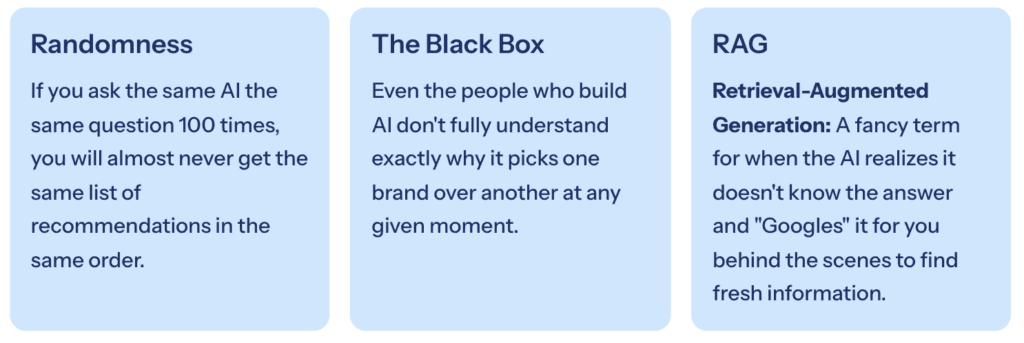
Randomness
If you ask the same AI the same question 100 times, you will almost never get the same list of recommendations in the same order.
The Black Box
Even the people who build AI don’t fully understand exactly why it picks one brand over another at any given moment.
RAG
Retrieval-Augmented Generation: A fancy term for when the AI realizes it doesn’t know the answer and “Googles” it for you behind the scenes to find fresh information.
Because AI is a “probability machine,” your goal as a marketer is to make your brand the most probable answer. You do this by making sure your brand name appears consistently across the web in trusted places like news sites, reviews, and social media.
New Rules for Your Content: The 44% Rule
If you want an AI to “cite” your website, you have to write in a way that machines like. Machines have a “short attention span” because processing information costs the AI companies a lot of money.
44.2%
The 44% Rule
New research shows that 44.2% of ChatGPT citations come from the first 30% of a page’s content. In the old days, we wrote “Ultimate Guides” where the best stuff was at the end. In 2026, you must “front-load” your insights. Put your definitions, answers, and conclusions right at the top.
20%
Entity Richness
Cited content usually has about 20% proper nouns (names of people, tools, brands), while normal writing only has 5%.
5%
Normal Writing
Standard writing only contains about 5% proper nouns — far below what AI-cited content requires.
The Traits of Winning Content
Entity Richness
This means using a lot of proper nouns (names of people, tools, brands). Cited content usually has about 20% proper nouns, while normal writing only has 5%.
Definitive Language
Don’t be vague. Use phrases like “X is…” or “X refers to…” because AI loves clear definitions.
The “Clarity Tax”
If you use “fluff” or confusing words, the AI will ignore you. This is the “tax” you pay for not being clear.
Avoid AI Tics
Starting a paragraph with “In conclusion” or using “Not only… but also” too many times can actually make readers leave your site faster.
Local SEO: Winning Your Neighborhood in the AI Era
If you have a physical business, like a pizza shop or a law firm, things have changed on mobile phones. Traditional Google Maps results are being replaced by AI Map Packs. These appear for about 44% of local searches.
How to Win Local AI Search
Reviews are the Main Entree
Reviews are no longer a “side dish.” They are the most important factor. 98% of people read reviews before choosing a local business. AI tools like “Know Before You Go” actually read your reviews to tell customers what to expect.
Keywords in Your Name
Surprisingly, having a keyword in your business name is still the #3 biggest ranking factor. Some businesses are legally changing their names to include their city or service just to rank higher.
The “Open Now” Boost
Being open at the time of the search is the #5 most important factor. If your competitors close at 5:00 PM and you stay open until 6:00 PM, you will shoot to the top of the rankings during that hour.
Don’t Forget Bing
ChatGPT often gets its local data from Bing Places, Facebook, and Yelp. If you only focus on Google, you might be invisible in ChatGPT.
Paid Ads: ChatGPT Enters the Game
The wall between “Organic” (free) results and “Paid” ads has fallen. In 2026, ads are showing up right inside AI conversations.
The ChatGPT Ad Era
Ads now appear in ChatGPT on the very first prompt. If you ask, “What is the best way to book a weekend away?”, you might see a “Sponsored” brand right under the AI’s answer. These ads are “contextual,” meaning they are based on what you are talking about right now, not just a keyword you typed.
AI Monitoring of Leads
If you run “Local Services Ads” (the ones at the very top of Google), Google is now “listening” to your calls. They use AI to transcribe the call and see if your staff was polite and if you actually helped the customer. If your staff is rude or doesn’t answer the phone, Google might stop giving you leads and give them to your competitors instead.
The Strategy
Marketers now have to coordinate. The person doing SEO and the person buying ads have to use the same “prompt intelligence” to make sure the brand is answering the right questions.

Avoiding “AI Jail”
The internet has developed what experts call a “Machine Immune System”. This is a network of AI bots that remember everything they find on the web.
If your website has a flaw — like being too slow, having broken links, or using fake information — the machines “log” that mistake. They then share those “memories” with other systems.

How to Stay Out of Trouble
Avoid “Too Much SEO”
Ironically, doing too many old-school SEO tricks (like keyword stuffing) can get you in “Google Jail”.
The Risk of AI Content
If you use AI to write thousands of low-quality pages just to get traffic, Google will likely demote your entire site.
The “Helper” Rule
Google is cracking down on “self-promotional listicles” — articles where a company ranks itself as #1 without proof.
Technical Integrity
Machines don’t like friction. If your site is technically “messy,” the AI “immune system” will simply stop visiting you to save energy.
Once a machine decides you are “unreliable,” it is very hard to fix that “scar tissue”. Recovery can take years.
How to Measure Success in the World of AI
In the old days, we measured success by “Rankings” (being #1 on Page 1) and “Clicks. But in a “Zero-Click World,” where people get the answer from the AI and never visit your site, those metrics don’t work anymore.
We have a new metric for 2026: LCRS, or LLM Consistency and Recommendation Share.
Consistency
How often does the AI mention your brand when someone asks a related question? Does it mention you every time, or just once in a while?
Recommendation Share
When the AI gives a list of options, how often are you the first choice?
Even if you don’t get a click, being “the recommended brand” builds trust. People who find you through an AI convert (buy) at an 18% rate, which is much higher than any other channel. This is because the AI has already “vetted” you for the customer before they ever landed on your site.
18%
AI Conversion Rate
People who find you through an AI convert at an 18% rate — much higher than any other channel.
25%
Drop in Blue-Link Clicks
Traditional search volume — people clicking on old “blue links” — is predicted to drop by about 25% this year.
44%
Local AI Map Packs
AI Map Packs now appear for about 44% of local searches, replacing traditional Google Maps results.
The WordPress Technical Checklist
If you use WordPress, you have a head start, but you need to make sure your site is “machine-readable”.
1. Semantic HTML
Use the “Gutenberg” block editor correctly. Use H1 for your title, H2 for big sections, and H3 for sub-points. AI treats these headers like “prompts” and the text below them as the “answer”.
2. Schema Markup
Use plugins to add “Schema” (code that tells search engines exactly what an entity is). Make sure you have Organization, FAQ, and Product schema.
3. Robots.txt
Make sure you aren’t accidentally blocking bots like GPTBot or Claude-User. If you block them, you might protect your content, but you will also become invisible in those AI tools.
4. Core Web Vitals
Your site must load fast. If it takes more than 3 seconds, users — and the machine immune system — will leave.
5. Mobile-First
64% of traffic is now on phones. If your site looks bad on a phone, Google and AI models will rank you lower.
The Path Forward in 2026

Marketing in 2026 is no longer just about “winning keywords.” It is about Search Presence Engineering.
To win, you must stop trying to “game the system” and start trying to be the most obvious, helpful, and trusted answer for your specific audience.
Your 3-Step Action Plan
Research Your Audience
Use tools to find out what words they actually use when they are confused or comparing options.
Be Everywhere
Make sure you have a presence on Reddit, YouTube, and news sites, because that is where the AI learns about you.
Prioritize Clarity
Write content that gives direct answers up front. Don’t hide your best stuff at the bottom of the page.
The “Pinball Journey” is chaotic, but it is also a huge opportunity. If you can provide a clear, consistent message across all the platforms, you will be the one the AI recommends — and the one the customer trusts.
Online Marketing and AI Data Sources for Q1 2026
Below is a bulleted list of the data sources referenced in this guide, including direct or inferred links where available based on the source material.
- 17 Local Developments You Need to Know About from Q4 2025 | Whitespark – View Source
- 44% of ChatGPT citations come from the first third of content: Study | Search Engine Land – View Source
- 7 Local Search Ranking Factors That May Challenge Your Current Thinking | Whitespark – View Source
- A Reflection on SEO, GEO & AI Search in 2025 | Lily Ray – View Source
- A page is more than just a container for words | Jono Alderson – View Source
- AAO: Why assistive agent optimization is the next evolution of SEO | Search Engine Land – View Source
- AI agents in SEO: A practical workflow walkthrough | Search Engine Land – View Source
- Anthropic clarifies how Claude bots crawl sites and how to block them | Search Engine Land – View Source
- Are Citations in AI Search Affected by Google Organic Visibility Changes? | Lily Ray – View Source
- Browser extensions with 8 million users collect extended AI conversations | Ars Technica – View Source
- ChatGPT ads collapse the wall between SEO and paid media | Search Engine Land – View Source
- ChatGPT ads spotted and they are quite aggressive | Search Engine Land – View Source
- Debunking The Myth That Search Is Dying | Graphite.io – View Source
- Google Search Console AI-powered configuration rolling out | Search Engine Land – View Source
- Google’s December 2025 Core Update: Winners, Losers & Analysis | Amsive – View Source
- How ChatGPT uses SEO to drive growth and revenue | Search Engine Land – View Source
- How Google Discover qualifies, ranks, and filters content: Research | Search Engine Land – View Source
- How to Outrank 99% of Local Competitors – Google Business Profile Tier List | Whitespark – View Source
- If You’ve Been Investing in SEO, You’re on the Right Track With GEO: An AMA With Lily Ray | Moz – View Source
- Is Google Finally Cracking Down on Self-Promotional Listicles? | Lily Ray – View Source
- LLM consistency and recommendation share: The new SEO KPI | Search Engine Land – View Source
- Marketing against the machine immune system | Jono Alderson – View Source
- Mastering generative engine optimization in 2026: Full guide | Search Engine Land – View Source
- NEW Research: AIs are highly inconsistent when recommending brands or products | SparkToro – View Source
- NEW in SparkToro: Take Action combines real audience data with LLM magic | SparkToro – View Source
- NEW: AI Tool & Social Network Usage Graphs are in SparkToro | SparkToro – View Source
- Never Ask an AI Tool How It Came Up with That Answer | SparkToro – View Source
- Optimising for the surfaceless web | Jono Alderson – View Source
- Rel Canonical Is Just A Hint | GSQi Case Studies – View Source
- Site redesign checklist to preserve SEO & improve visibility | Search Engine Land – View Source
- Stop trying to rank for keywords | Jono Alderson – View Source
- The 5 Big Trends that Will Dominate Marketing in 2026 | SparkToro – View Source
- The 7 Marketing Problems Pinball-Shaped Buyer Journeys Create | SparkToro – View Source
- The AI writing tics that hurt engagement: A study | Search Engine Land – View Source
- The authority era: How AI is reshaping what ranks in search | Search Engine Land – View Source
- The death of a website | Jono Alderson – View Source
- The Pinball Customer Journey Has Replaced the Marketing Funnel | SparkToro – View Source
- Vibes Meet Facts: Write Like the Smart Human You Are | SparkToro – View Source
- Want to Rank in ChatGPT? Focus on These Review Sites (New Research) | Whitespark – View Source
- What 13 months of data reveals about LLM traffic, growth, and conversions | Search Engine Land – View Source
- Why Everyone Prompts AI Differently (Even When They Want the Same Thing) | SparkToro – View Source
- Why Sites Lose Rankings: The ‘Too Much SEO’ Problem with Lily Ray | YouTube (Navneet Kaushal channel) – View Source
Report Brought to You By
Growth Lab
Growth Lab is a legal marketing agency focused exclusively on helping fast-growth law firms increase online visibility, strengthen their search presence, and generate more qualified cases through SEO, PPC, LSAs, AI, Earned Media, and Website strategies. With a data-driven approach and a strong emphasis on transparency, Growth Lab partners with firms that want measurable marketing results.

