
What Is SEO for Lawyers?
Law firm SEO is the process of improving a legal website’s visibility in search engine results so that potential clients find your firm before they find your competitors. It covers everything from the content on your practice area pages to the technical structure of your site to the links pointing back to it from other authoritative sources. Whether you’re comparing options as an SEO agency for law firms or building a strategy in-house, the fundamentals stay the same.
Legal SEO differs from standard SEO in a few meaningful ways. The competition is intense, the stakes for searchers are high, and Google applies stricter quality standards to legal content because of the real-world consequences bad advice can carry. Law firms also operate in a geography-specific market, which means local search performance is not a secondary concern. It is often the primary one.
The relationship between rankings, traffic, and case acquisition is direct. A firm ranking at position one for a competitive practice area term in its market will receive a significantly higher share of clicks than a firm at position five. More clicks mean more intake calls. More intake calls mean more cases. SEO for attorneys is not a branding exercise. It is a revenue driver.
If your firm is ready to turn that visibility into cases, our team can show you exactly where the opportunities are. Reach out through our contact form or call 866-811-4621 anytime.
Why Is SEO for Law Firms So Important?
The way people find legal help has changed permanently. When someone needs an attorney today, the search begins online, and it almost always begins on Google.
The National Law Review has reported that 96% of people seeking legal advice start with an online search. Google processes roughly 3.5 billion searches per day and holds over 91% of the global search engine market share. That is where your potential clients are, and that is where your firm needs to be visible.
Where you rank on that first page matters enormously. Data also shows the first organic result carries an average click-through rate of over 31% on desktop. After the first result, that rate drops sharply. Roughly half of all users select one of the first three organic results and stop there. Most searchers spend less than a minute deciding which result to click, so ranking position often determines who gets the call before a searcher even finishes reading the page.
In fact, less than 1% of users ever click on a result from Google’s second page, and the page that ranks first is up to 10 times more likely to earn a click than the page ranking tenth. For a law firm, that means a page two ranking is effectively invisible. Law firm SEO services exist to close that gap and move firms into the positions where clients are actually looking.
SEO vs. PPC for Law Firms: Which Is Better?
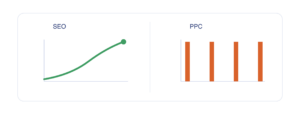
This is one of the most common questions law firm owners ask, and the honest answer is that it depends on where your firm is, what your goals are, and what your timeline looks like. Both channels drive traffic. Both have real advantages. Neither is universally better than the other.
SEO Benefits
SEO builds compounding visibility over time. A page that earns strong rankings through quality content and authoritative backlinks continues to generate traffic without an ongoing per-click cost. The investment is front-loaded, and the returns accumulate. For firms with a long-term growth mindset, SEO for law firms delivers a strong return on investment because the traffic it generates does not stop when the budget does.
PPC Benefits
PPC, or pay-per-click advertising, delivers immediate visibility. A firm that launches a Google Ads campaign can appear at the top of search results the same day. That makes PPC particularly valuable for new firms without established organic rankings, firms entering a new practice area, or campaigns tied to a specific window of time.
Timeline Difference
The timeline difference is significant. SEO typically takes three to six months to show meaningful movement and six to twelve months to reach competitive positions in most markets. PPC produces results from day one but requires continuous spend to maintain placement.
Cost Comparison and Long-Term ROI
Cost comparison depends heavily on the market. Legal PPC keywords are among the most expensive in any industry. In major metros, a single click on a personal injury or criminal defense keyword can cost well over one hundred dollars. SEO requires long-term investment in content, links, and technical work, but that investment does not disappear the moment spending pauses.
When Law Firms Should Use Both
For most established law firms, the strongest approach is to use both channels together. PPC captures immediate demand while SEO builds the long-term foundation. Over time, as organic rankings strengthen, firms often shift budget allocation toward SEO as the cost per acquisition through organic search decreases.
Lawyer SEO: Common Mistakes and How to Avoid Them
When embarking on an SEO strategy for your law firm, it’s crucial to be aware of common pitfalls that can hinder your success. Here are some mistakes to avoid:
- Hiring a Cheap SEO Company for Lawyers: While it might be tempting to cut costs, hiring a low-cost agency often results in subpar services. These companies may lack the expertise needed to effectively optimize your law firm’s website, leading to poor search engine rankings and minimal client growth.
- Buying Low-Quality Backlinks: Backlinks are essential for building your law firm’s online authority, but purchasing low-quality links can harm your search engine rankings. Search engines may penalize your site for engaging in such practices, which can significantly impact your online visibility.
- Keyword Stuffing: Overloading your content with keywords in an attempt to manipulate search engine rankings is a strategy that can backfire. Search engines prioritize user experience and may penalize sites that engage in keyword stuffing, resulting in lower rankings.
- Generating Purely AI Content: While AI tools can assist in content creation, relying solely on them can lead to generic, unengaging content. It’s important to infuse your content with authentic insights and expertise to resonate with prospective clients and establish your law firm’s credibility.
- Pasting Content from Another Website: Duplicate content can severely impact your site’s search engine rankings. Search engines prioritize original content, so ensure that your website features unique, valuable information tailored to your audience’s needs.
By avoiding these common mistakes, law firms can build a robust website marketing strategy that enhances their online presence, attracts more qualified leads, and drives sustainable client growth.
What Ranking Factors Does Your Site Need to Rank in the Top Spots on Google?
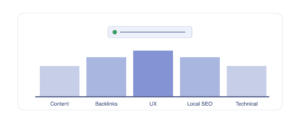
Google evaluates hundreds of signals when deciding which pages to rank and in what order. For law firms, five categories of factors carry the most weight.
High-Quality Legal Content
Content is the foundation of any law firm SEO strategy. This includes practice area pages that clearly explain what your firm handles, location pages that connect your services to the specific cities and regions you serve, and informational content that answers the questions potential clients are searching for before they ever pick up the phone.
Google rewards topical authority, which means the more thoroughly your site covers a subject area, the more confidently the search engine treats your domain as a reliable source on that topic. A personal injury firm with detailed pages covering car accidents, truck accidents, slip and fall claims, wrongful death, and premises liability will consistently outperform a firm with a single generic personal injury page.
Backlinks and Authority
Backlinks are links from other websites pointing to yours. Google treats them as votes of confidence. A backlink from a respected legal publication or a regional news outlet carries far more weight than a link from a low-quality directory.
For law firms, authority-building includes earning links through digital PR, contributing bylined content to legal publications, maintaining accurate citations across attorney directories like Avvo, Justia, and Martindale-Hubbell, and appearing in local press coverage. The quality of backlinks matters considerably more than the quantity.
User Experience Signals
Google monitors how users interact with your site. If visitors land on a page and leave immediately, that signals the content did not answer their question. If they stay, scroll, and navigate to other pages, that signals relevance and quality.
Navigation should be intuitive. Pages should load quickly. Mobile usability is not optional. Over half of legal searches now happen on mobile devices, and a site that performs poorly on a phone will lose those visitors before they ever read a word of your content. Google’s Core Web Vitals metrics measure loading speed, interactivity, and visual stability, and all three affect rankings.
Local SEO Signals
For most law firms, local search performance determines whether the phone rings. The Google Business Profile is the single most important local SEO asset a firm can maintain. A complete, accurate, and regularly updated profile improves visibility in the local map pack, which appears above organic results for most practice area searches.
Reviews are a direct local ranking signal. Firms with a consistent volume of positive Google reviews outperform competitors with fewer or older reviews. Local citations, meaning consistent name, address, and phone number listings across directories and data aggregators, reinforce the geographic relevance of your firm to Google’s local algorithm.
Technical SEO
Technical SEO ensures that Google can find, crawl, and index your content without obstacles. This includes site architecture that keeps important pages accessible within a few clicks from the homepage, internal linking that distributes authority across the site, schema markup that helps Google understand the type of content on each page, and a clean URL structure that reflects the hierarchy of your content.
A technically sound site is the infrastructure that everything else depends on. Strong content and backlinks cannot fully compensate for a site that Google struggles to crawl.
How AI Tools Discover and Cite Law Firms

Search behavior is shifting. A growing number of users are turning to AI-powered tools, including ChatGPT, Google AI Overviews, Perplexity, and Gemini, to get answers before they ever click a search result. For law firms, this creates a new layer of visibility to consider.
AI systems do not operate on an entirely different set of criteria than traditional search engines. They draw from authoritative content, structured data, trusted mentions across the web, and signals that indicate a source is credible and relevant. The same practices that improve Google rankings tend to improve the likelihood that an AI tool will surface your firm in a generated response.
Specific factors that increase the chances of AI citation include:
- A well-maintained Google Business Profile
- Consistent and positive client reviews
- Presence in reputable legal directories
- Schema markup that clearly identifies your firm’s name, location, and practice areas
- Content that directly and accurately answers the questions users are asking
Topical authority matters here as well. A firm whose website thoroughly covers a practice area is more likely to be recognized as a relevant entity when an AI tool is assembling a response about that topic.
Entity recognition is a concept worth understanding. Google and AI systems increasingly think in terms of entities, meaning named people, organizations, and places with defined characteristics, rather than just keywords. A law firm that appears consistently across authoritative sources with consistent information becomes a recognized entity, which improves both search and AI visibility.
Why Website Design Matters for Law Firm SEO
Mobile User Experience
More than half of legal searches happen on a phone. A site that loads slowly, displays content incorrectly, or requires pinching and zooming to read will lose those visitors immediately. Google uses mobile performance as a ranking signal, so a poor mobile experience affects not just conversions but visibility.
Site Structure and Navigation
A clear site structure helps both users and search engines. Visitors should be able to find your practice area pages, attorney bios, and contact information within two or three clicks from any page. A logical internal linking structure distributes authority across the site and ensures Google can index all of your content efficiently.
Converting Website Visitors Into Leads
Traffic without conversion is wasted. A well-designed law firm website moves visitors from arrival to contact through clear calls to action, accessible phone numbers, prominent contact forms, and content that builds enough confidence to prompt outreach. Page layout, load speed, and the clarity of your value proposition all affect whether a visitor becomes an intake call.
Trust Signals and Attorney Credibility
Potential clients are making a significant decision when they choose a law firm. A website that displays attorney credentials, bar admissions, case results, and genuine client reviews gives visitors the confidence to reach out. These trust signals also contribute to Google’s E-E-A-T evaluation, which stands for Experience, Expertise, Authoritativeness, and Trustworthiness, and directly affects how Google assesses the quality of legal content.
How to Measure Law Firm SEO Performance
Effective law firm SEO requires consistent measurement. The metrics that matter most include:
- Organic search traffic
- Keyword ranking positions for target practice area terms
- Conversion rate from organic visitors to contact form submissions or calls
- The volume and quality of leads generated through search
Google Search Console tracks keyword rankings and click-through rates. Google Analytics 4 shows how organic visitors behave on the site and whether they are completing conversion actions. Rank tracking tools like Semrush or Ahrefs provide competitive benchmarking and position change monitoring over time.
Reporting should connect SEO activity to business outcomes. Ranking improvements and traffic increases matter, but the measure that counts most for a law firm is whether SEO investment is generating cases.
Why Work With a Law Firm SEO Agency
Law firm digital marketing is a specialized discipline. Effective lawyer SEO marketing blends legal industry knowledge with proven search strategy, something general marketing agencies rarely offer. General SEO agencies often lack the legal industry knowledge to produce content that meets Google’s quality standards for YMYL, or Your Money or Your Life, content categories, under which legal content falls. A law firm marketing agency with dedicated legal experience understands how to write for both potential clients and search engines without sacrificing accuracy or credibility.
Growth Lab works exclusively with law firms. Our team develops and executes SEO strategies built around case acquisition, not vanity metrics. From content development and link building to technical audits and local SEO, our law firm SEO services are designed to move firms into the positions where clients are searching and convert that visibility into revenue.
Reach out through our online contact form or call us at 866-811-4621 to schedule an appointment and talk through what a targeted SEO strategy could look like for your firm.
